
Operations
Making Commercial HVAC Equipment Last Longer
Most rooftop units do not die of old age. They die of low airflow, wet cabinets and deferred cleaning.
3 min read · Reviewed by Gabriel M.
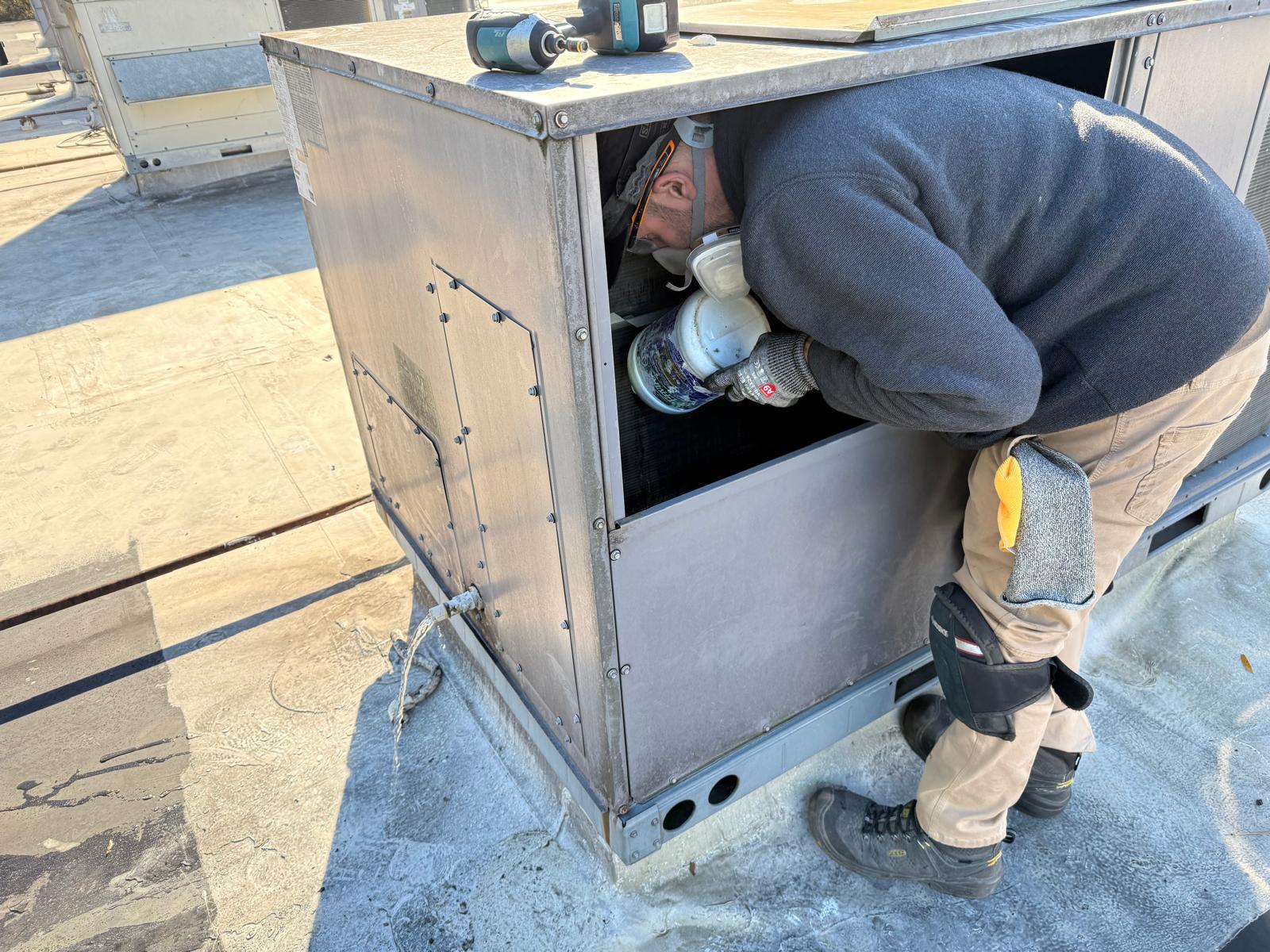
Rooftop RTU — coil sanitizing inside a packaged unit with respirator PPE
How restriction becomes failure
Low airflow across an evaporator drops suction pressure and returns liquid refrigerant toward the compressor. Low airflow across a gas heat exchanger creates hot spots that crack it. Debris-loaded blower wheels run out of balance and destroy bearings. None of these are exotic failure modes; they are the routine ending of a system that was never cleaned.
The moisture problem in Atlanta
Long humid cooling seasons keep coils and pans wet for months. A pan that will not drain corrodes the cabinet floor, wicks into insulation and seeds microbial growth that then travels downstream. Clearing condensate lines and verifying pan slope is unglamorous work that saves entire air handlers.
What a lifespan program looks like
Filter changes on an interval set by measured pressure drop rather than the calendar. Coil and pan service before and after peak cooling. Blower inspection annually. Full duct cleaning at the interval your occupancy requires. Documentation that carries forward so the next facility manager inherits a history instead of a mystery.
Common questions
- Is cleaning cheaper than replacement?
- By a wide margin, especially for rooftop equipment where crane and curb work dominates replacement cost.
- Can cleaning revive a failing unit?
- It can restore performance lost to fouling. It cannot fix worn bearings, a leaking coil or a cracked exchanger.
- How often should blower wheels be checked?
- Annually in most commercial settings, more often in kitchens and manufacturing.
Keep reading
Talk to a commercial crew, not a call center
Commercial Air Care services commercial facilities across Metro Atlanta with IICRC-certified crews and per-unit photo documentation on every job.