
Process
Negative Air and Source Removal, Explained Without the Jargon
Agitation without suction just redistributes debris. Here is how negative pressure turns cleaning into removal.
3 min read · Reviewed by Gabriel M.
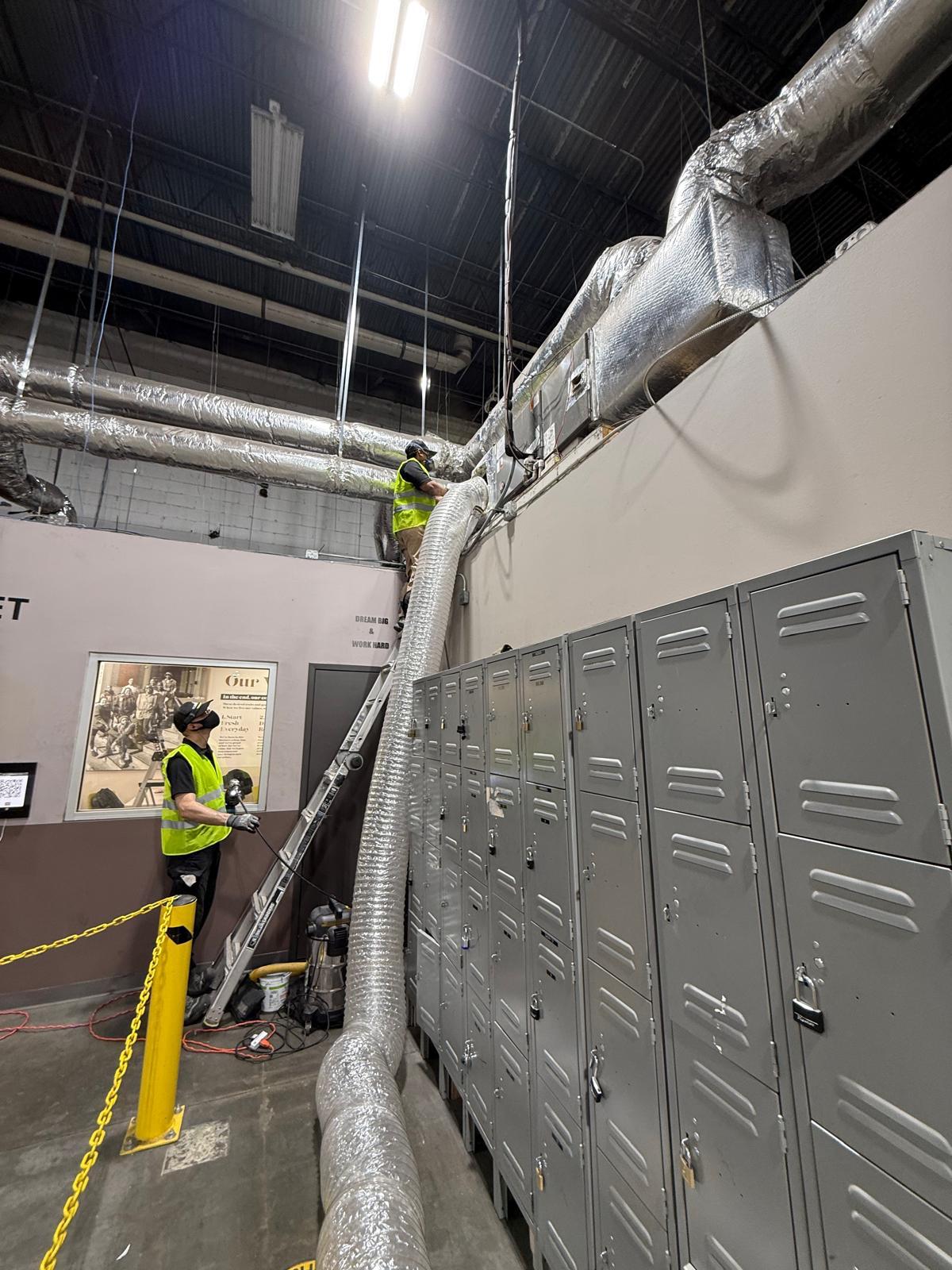
Plant locker room — overhead trunk and branch duct cleaning with negative-air containment
The principle in one sentence
Put the duct section under continuous suction first, then disturb what is inside it, so every particle you loosen has only one place to go. Reverse that order and you have turned the HVAC system into a distribution network for the dust you just freed.
What the equipment has to do
The collector needs enough airflow to hold measurable negative pressure across the isolated section, and HEPA filtration so the exhaust is cleaner than the room air. On large Atlanta plants and warehouses we stage multiple machines and re-isolate as the crew advances down the trunk.
Isolation matters as much as horsepower. Inflatable bladders or blank-offs close the run beyond the work zone; without them, suction dissipates across the whole system and nothing is under real negative pressure.
How to tell it was done properly
Ask where the machine was connected and how the section was isolated, and look at the photos. A clean interior surface immediately downstream of a work point with a visible dirt line further along is a sign the crew moved faster than the isolation did.
Common questions
- Is chemical fogging an alternative?
- No. Fogging can address microbial activity on a surface that is already clean; it removes nothing and does not restore airflow.
- Where does the exhaust go?
- Through HEPA filtration, usually discharged outside the building or back into the space only when filtration is verified.
- Is it loud?
- The machines are audible, which is one reason most occupied facilities schedule the work outside business hours.
Keep reading
Talk to a commercial crew, not a call center
Commercial Air Care services commercial facilities across Metro Atlanta with IICRC-certified crews and per-unit photo documentation on every job.