Fundamentals
What Commercial Air Duct Cleaning Actually Involves
Supply lines, returns, plenums, coils, blower housings and drain pans — what a real commercial scope includes and what it leaves out.
3 min read · Reviewed by Gabriel M.
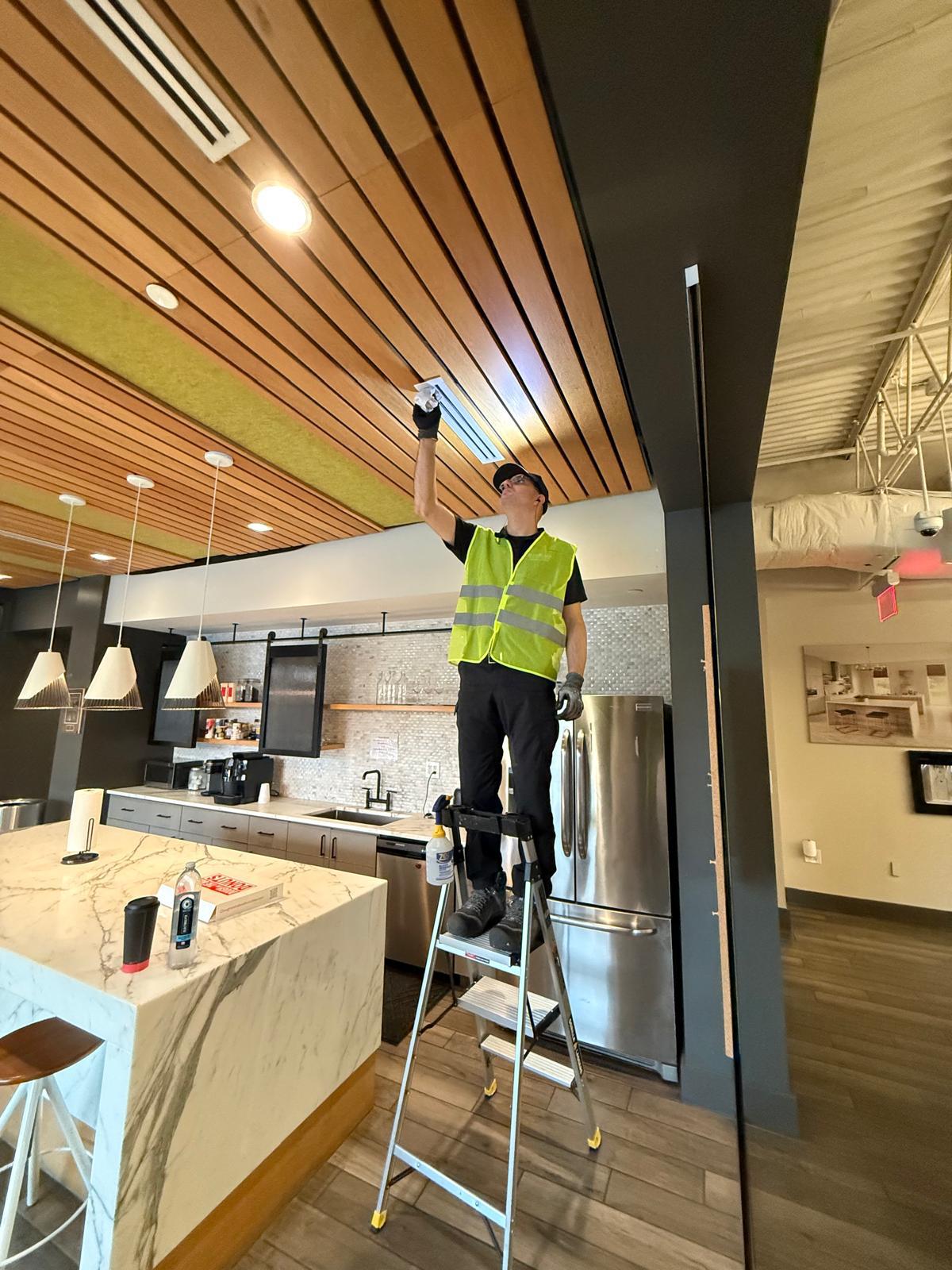
Corporate break room — linear diffuser cleaning above the kitchen island and prep counter
The system, not just the vents
When a facility manager asks for duct cleaning, what they usually picture is a technician vacuuming a few ceiling grilles. A commercial scope is broader than that: the air path starts at the outside-air intake, runs through filters, coil, blower and plenum, travels the trunk and branch lines, and returns through ceiling plenums or hard return ducts. Contaminants settle at every one of those stages, and cleaning only the visible end of the path leaves the source untouched.
On our Metro Atlanta jobs the scope is written per air handler rather than per room. Each unit gets its own access points, its own containment, and its own before-and-after photo set, so the building owner can see exactly which part of the system was serviced.
- ✓ Supply trunks, branch runs and diffusers
- ✓ Return air paths, including ceiling plenum returns
- ✓ Mixing box, filter rack and outside-air section
- ✓ Evaporator coil face and drain pan
- ✓ Blower wheel, motor housing and interior cabinet
What honest scope excludes
Duct cleaning is not duct repair, and it is not a substitute for mold remediation. If we open a system and find torn liner, crushed flex or standing water in a pan, that becomes a separate documented recommendation rather than something quietly absorbed into the cleaning.
Being clear about the boundary protects you. A contractor who promises that one cleaning will fix comfort complaints, balance problems and humidity issues is selling something the work cannot deliver on its own.
What you should be able to verify afterward
The result of a properly executed commercial cleaning is measurable, not anecdotal. Interior duct surfaces should pass a visual inspection with a camera or mirror, the coil face should be visible through the fins, and the blower wheel should show bare metal instead of caked buildup.
Ask for that evidence in writing. Our crews deliver a photo record per unit along with the areas serviced, the access points cut and resealed, and any conditions found that need follow-up.
Common questions
- Does duct cleaning include the air handler?
- In a commercial scope it should. Cleaning duct lines while leaving a fouled blower wheel and coil in place simply reloads the ductwork the next time the system runs.
- Will you need to cut access holes?
- Usually yes. Access panels are cut at strategic points, then sealed with rigid metal closures rated for the duct type so the system stays airtight afterward.
- How disruptive is the work?
- Most Atlanta facilities we serve stay open. Crews work zone by zone, often overnight or on weekends, and containment keeps dust out of occupied areas.
- Do you clean flex duct?
- Yes, with soft-bristle agitation and controlled pressure. Flex that is torn, compressed or internally shedding is flagged for replacement instead of cleaned.
Keep reading
Talk to a commercial crew, not a call center
Commercial Air Care services commercial facilities across Metro Atlanta with IICRC-certified crews and per-unit photo documentation on every job.